

Retrenchment Package Calculator
Based on Basic Conditions of Employment ActYou have 30 days from the date of your dismissal to refer an unfair retrenchment to the CCMA. Most people do not know this, and even fewer know how to work out whether the number on their retrenchment letter is actually correct. If you have just been told your job is being cut, the first thing you need is not sympathy. It is a working retrenchment package calculator that tells you, in Rands, what the law says your employer owes you.
This article walks you through exactly how that calculation works, what counts as your real package beyond severance pay, and where South African employees commonly get shortchanged without realising it. Whether you are trying to check a number your HR department already gave you, or you are preparing for a retrenchment that has not happened yet, you need this before you sign anything.
What a Retrenchment Package Calculator Actually Adds Up
A proper retrenchment package calculator does not just spit out one number. Your final payout is made up of several separate entitlements, and each one has its own legal basis. Lumping them together, or worse, letting your employer lump them together on a single line item, is how people lose money without noticing.
Your package should include:
- Statutory severance pay, calculated under Section 41 of the Basic Conditions of Employment Act
- Notice pay, if you are not required to work your full notice period
- Accrued but untaken leave pay
- Any pro-rata bonus or thirteenth cheque owed up to your last day
- Payment for any outstanding expense claims or commission already earned
Your employer might present these as one lump sum. You are entitled to see the breakdown, and you should insist on it before you sign a separation agreement.
How the Statutory Severance Minimum Is Calculated
The BCEA sets the legal floor. Section 41 says your employer must pay you at least one week's remuneration for every completed year of continuous service. This is a minimum, not a suggestion, and not something your employer can negotiate down.
The formula is simple: take your weekly rate of pay, multiply it by your years of completed service. Most employers convert this to a monthly figure for ease, which works out to roughly one week's pay per year, or about a quarter of a month's salary per year of service.
Here is a working example. If your basic salary is R18,000 per month and you worked for 6 years, your statutory minimum severance is R18,000 divided by 4.33 weeks, giving a weekly rate of about R4,157, multiplied by 6 years, which comes to roughly R24,942. Some employers simplify this further and pay one week's salary per year using a slightly different weekly conversion, so small differences between R24,000 and R25,000 are normal and not automatically a red flag.
Now look at a longer service example. If you earned R25,000 per month and worked for 8 years, many employers round this to R25,000 x 8 percent per year of a monthly figure, but the cleaner way to check it is: weekly rate of roughly R5,774, multiplied by 8, giving approximately R46,192 as your statutory minimum. Anything below this figure is a breach of Section 41, and you have grounds to query it immediately.
Remember this is the floor, not the ceiling. Many employers, particularly larger corporates with retrenchment policies or bargaining council agreements, pay more than the statutory minimum. Your contract, your company policy, or a collective agreement can all improve on what the BCEA requires. Never assume the statutory number is the final number until you have checked your contract and any applicable policy.
Severance Pay vs Notice Pay vs Leave Pay
People frequently confuse these three, and confusing them is exactly how a retrenchment package calculator gets misused, whether by accident or on purpose.
| Payment Type | What It Covers | Legal Basis |
| Severance Pay | Compensation for job loss due to retrenchment | Section 41, BCEA |
| Notice Pay | Payment in lieu of your notice period if not worked | Section 37, BCEA, or your contract |
| Leave Pay | Accrued annual leave not yet taken | Section 20, BCEA |
These three payments are calculated separately and none of them substitutes for another. In practice what most retrenched employees find is that their employer bundles all three into a single "package amount" without itemising it. Ask for a written breakdown. If your employer refuses, that alone is worth raising with the CCMA or a labour lawyer before you sign anything.
The Consultation Process Matters as Much as the Number
A retrenchment package calculator only gives you an honest answer if the retrenchment process that led to it was fair. Section 189 of the Labour Relations Act requires your employer to consult with you, or your union, before any final decision is made. This is not a formality. Your employer must give you written reasons for the proposed retrenchment, consider alternatives to dismissal, and give you a genuine chance to respond before the axe falls.
Larger retrenchments, generally more than 10 to 50 employees depending on company size, trigger Section 189A, which adds a facilitated process through the CCMA and stricter timelines. A common situation is an employer skipping proper consultation entirely and simply handing over a retrenchment letter with a number attached. If that happened to you, the process itself may be unfair even if the severance calculation is technically correct, and you have 30 days from your dismissal date to refer the matter to the CCMA.
A Common Mistake: Confusing Your Full Package With Your Take-Home Amount
Many workers make the mistake of assuming the number their retrenchment package calculator produces is what lands in their bank account. It is not, and this catches people out badly when they are budgeting for months of unemployment ahead.
Severance pay has a specific tax treatment under the Income Tax Act. The first R500,000 of severance benefits, cumulative across your lifetime, is tax free, provided you have not used up this exemption on a previous retrenchment or retirement payout. Amounts above that threshold are taxed according to the lump sum tax tables, and your employer or fund administrator needs a SARS tax directive before paying out anything beyond the ordinary course. If you have received a retrenchment payout before, even years ago, your R500,000 lifetime exemption may already be partly or fully used, and this is one of the most overlooked details in any retrenchment calculation.
Notice pay and leave pay, by contrast, are taxed as normal income at your marginal rate, not under the more favourable lump sum tables. This means a package that looks like R300,000 on paper can land in your account as a noticeably smaller number once SARS has taken its share of the non-severance components.
What Happens to Your Two-Pot Retirement Savings
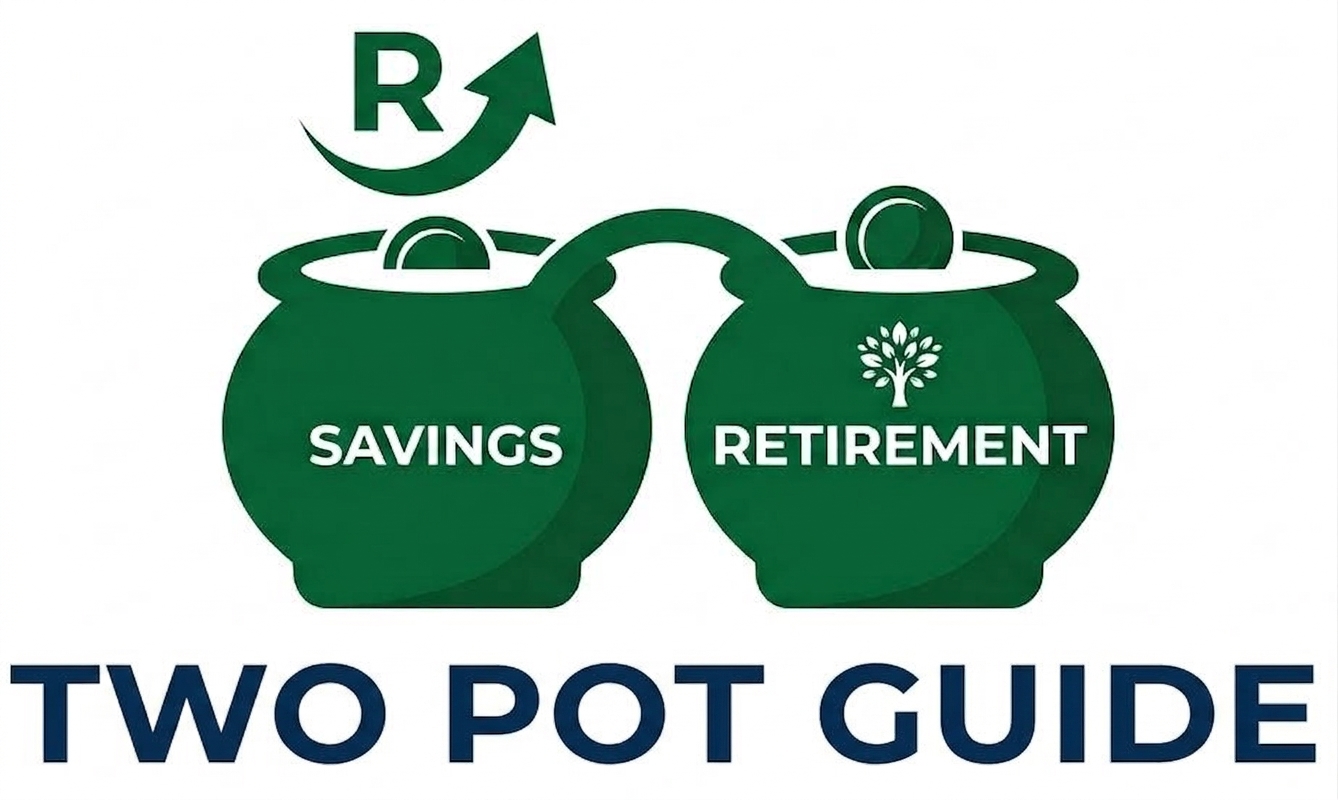
If you contribute to a provident fund or retirement annuity, your retrenchment also affects your two-pot retirement savings. Since the two-pot system came into effect, your retirement contributions are split into a savings pot, accessible before retirement, and a retirement pot, which stays locked in until you retire.
When you are retrenched, you can usually access your full fund value, both the savings pot and any vested amount from before the two-pot changes, subject to the fund rules and a SARS tax directive. The retirement pot portion generally remains preserved unless you formally withdraw from the fund entirely rather than transfer it. A common situation is retrenched employees cashing out their entire provident fund in a panic, without realising the tax consequences are steeper on a full withdrawal than on a partial one, and without checking whether preserving part of it under the Pension Funds Act rules would leave them better off long term. Before you touch your fund, get a proper breakdown from your fund administrator of what is savings pot, what is retirement pot, and what the tax directive will actually cost you.
Claiming UIF After Your Retrenchment
Your retrenchment package calculator should also factor in that severance pay does not replace your UIF claim. You are entitled to both. Once you have received your Certificate of Service and UI-19 form from your employer, you can register and claim through ufiling.labour.gov.za or in person at your nearest Department of Employment and Labour office. Your UIF benefit is calculated on a sliding scale based on your salary and how long you contributed, and delays in submitting your documents are the single biggest reason people wait months for a payout that should have taken weeks.
Frequently Asked Questions
How do I calculate my retrenchment package in South Africa?
Add your statutory severance pay (one week's pay per completed year under Section 41 of the BCEA), any notice pay owed, accrued leave pay, and pro-rata bonus. Check your contract and company policy separately, since many employers pay more than the statutory minimum.
Is severance pay taxable in South Africa?
The first R500,000 of severance benefits over your lifetime is tax free under the Income Tax Act, provided you have not used this exemption on a previous payout. Amounts above that are taxed according to the retirement lump sum tables, and a SARS tax directive is required before payment.
Can my employer pay less than the statutory minimum severance?
No. Section 41 of the BCEA sets one week's pay per completed year of service as the legal minimum. Your employer can pay more through contract or policy, but never less, unless a bargaining council agreement sets a different structure that still meets or exceeds this floor.
What if I think my retrenchment was unfair?
You have 30 days from your dismissal date to refer the matter to the CCMA. This applies whether you are disputing the process under Section 189 of the LRA, the severance calculation itself, or both.
Before you sign any separation agreement, get a full written breakdown of every component in your package: severance, notice, leave, and bonus, each calculated separately. Check the severance figure against the Section 41 minimum yourself using your actual weekly rate, not a rounded estimate from HR.
If the numbers do not add up, or the consultation process felt rushed or one-sided, you still have time to act, but that window is only 30 days. Before you decide what to do with your severance package, understanding how your two-pot retirement savings are affected by retrenchment could save you thousands in tax.
This article is for informational purposes only and does not constitute legal or financial advice. Labour law and tax rules may change. For advice specific to your situation, consult a registered labour lawyer, a CCMA commissioner, or visit labour.gov.za and sars.gov.za.