

You have 30 days from the date of your dismissal to refer an unfair retrenchment to the CCMA. Most people do not know this, and by the time they start asking questions, weeks have already passed. If you have just been told your job is being cut, or you suspect it is coming, the single most useful thing you can do right now is understand exactly what a retrenchment package must include under South African law. This is not a grey area.
The Basic Conditions of Employment Act sets a minimum, the Labour Relations Act sets a process, and SARS has clear rules about how your payout gets taxed. This article walks through what your employer owes you, what the process must look like, where people get caught out, and what happens to your pension or provident fund money when your job disappears.
What a Retrenchment Package Must Legally Include
Under Section 41 of the BCEA, your employer must pay you severance pay of at least one week’s pay for every completed year of continuous service. That is the statutory floor, not a suggestion. If your basic salary is R25,000 per month and you worked for 8 years, your minimum statutory severance is R25,000 divided by 4.33 weeks, multiplied by 8, which comes to roughly R46,200. Some employers simplify this to one month’s salary per year worked in their contracts or bargaining council agreements, which is more generous than the legal minimum, so always check your contract and any collective agreement first.
A full retrenchment package is not just severance pay. It also includes payment for your notice period if you are not required to work it, payment for any accrued but untaken annual leave, and payment for any outstanding salary up to your last day. Many employees only look at the severance figure and miss that these other components are owed separately and must appear on your final payslip. In practice what most retrenched employees find is that their employer bundles all of this into one lump sum without breaking it down clearly, which makes it hard to check whether you were paid correctly.
Severance Pay vs Notice Pay vs Leave Pay
These three payments often get confused, even though they are calculated differently and taxed differently in some cases. Here is a simple breakdown.
| Payment Type | What It Covers | Legal Basis |
| Severance Pay | Compensation for job loss, minimum one week per completed year | Section 41, BCEA |
| Notice Pay | Payment in lieu of your notice period if not worked | Section 37, BCEA |
| Leave Pay | Payment for accrued, untaken annual leave | Section 40, BCEA |
If your basic salary is R18,000 per month and you worked for 6 years with one month’s notice and 10 days of accrued leave, your retrenchment package should include roughly R24,900 in statutory minimum severance, R18,000 in notice pay, and around R8,300 in leave pay, before tax. That is a meaningful difference from just looking at the severance line alone.
The Section 189 Process Your Employer Must Follow
A retrenchment package only becomes lawful if your employer followed a fair process to get there. Section 189 of the Labour Relations Act requires your employer to consult with you or your union before any final decision is made. This is not a formality they can skip by handing you a letter on a Friday afternoon. Your employer must give you written notice of the reasons for the proposed retrenchment, explain the selection criteria being used to decide who goes, and give you a genuine chance to suggest alternatives such as short time, redeployment, or voluntary severance.
If your employer is retrenching a large number of employees at once, typically more than the thresholds set out in Section 189A, a facilitator from the CCMA may be appointed to oversee the process. A common situation is that smaller employers skip proper consultation entirely and simply issue retrenchment letters. If that happened to you, the retrenchment itself may be procedurally or substantively unfair, and you can refer this to the CCMA within 30 days of your dismissal, or to the Labour Court in larger disputes. Missing that 30 day window usually means losing your right to challenge it, so do not sit on this.
The Mistake Most People Make: Assuming the Package Offered Is the Legal Minimum
A common misconception is that whatever figure appears in the retrenchment letter is automatically what the law requires. It is not. Many workers make the mistake of signing a settlement agreement or accepting the first number offered without checking it against Section 41. Employers sometimes calculate severance using your basic salary only, which is correct, but occasionally they exclude allowances or commission that should have formed part of your ordinary remuneration for this calculation, understating what you are owed.
Another mistake is assuming that accepting a severance package means you give up your right to challenge the fairness of the retrenchment. Signing to accept payment and signing away your CCMA rights are two separate things, and you should read any settlement agreement carefully, or have a labour lawyer look at it, before you sign anything that waives further claims. If your employer pressures you to sign immediately without time to consider it, that pressure itself can be a warning sign worth raising with the CCMA.
How Your Retrenchment Package Is Taxed
SARS treats severance pay as a lump sum benefit with its own tax table, separate from your normal monthly income tax. The first R550,000 of qualifying severance benefits, combined with any retirement fund lump sums you take at the same time, is currently tax free under the Income Tax Act lump sum tables, with graduated rates applying above that threshold. Your employer or fund administrator applies for a SARS tax directive before paying out, so the tax has usually already been calculated by the time you receive your money. If you believe the tax deducted looks wrong, you or your accountant can query the directive with SARS directly.
Notice pay and leave pay, by contrast, are usually taxed as normal income at your regular PAYE rate, not under the lump sum tables. This is why your final payslip can look confusing, with different tax treatment applied to different lines within the same retrenchment package.
What Happens to Your Pension, Provident Fund, and Two-Pot Savings
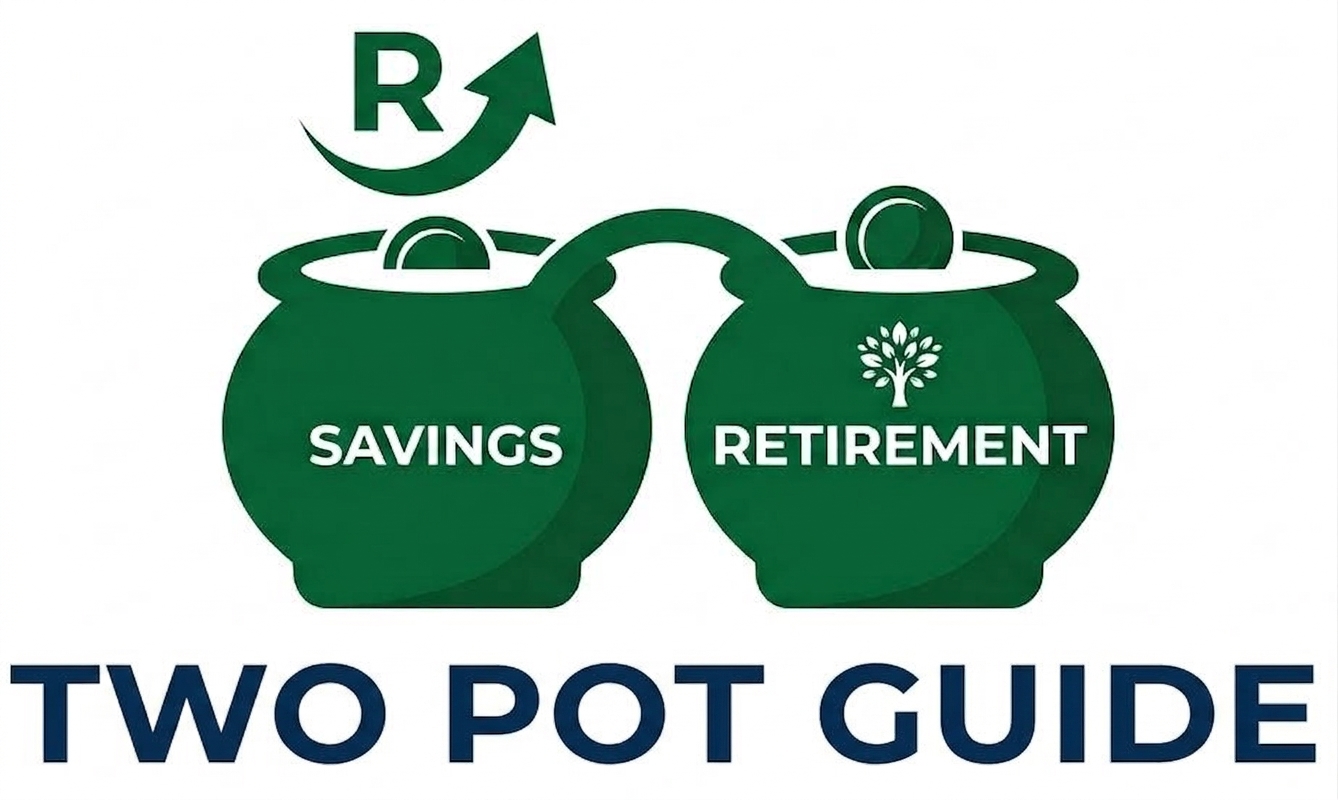
Retrenchment also triggers decisions about your retirement savings that many employees rush through under stress. When you leave a pension or provident fund due to retrenchment, you can withdraw the full amount, transfer it to a preservation fund or retirement annuity, or split it between the two. Since the two-pot retirement system came into effect, your fund is now split into a savings pot, a retirement pot, and a vested pot, and how these are treated on retrenchment depends on which pot the money sits in. Your accessible savings pot can typically still be withdrawn, but your retirement pot must be preserved until retirement, transferred, or annuitised, not paid out as cash even during retrenchment. Whether you cash out or preserve makes a large difference to how much tax you pay now versus what you will have available later, and this decision deserves its own careful look before you act.
Claiming UIF After Your Retrenchment Package Is Paid
Your retrenchment package and your UIF claim are two separate things, and you are entitled to both. Once you are retrenched, you can register and submit your claim through ufiling.labour.gov.za or at your nearest Department of Employment and Labour office, using your UI-19 form from your employer along with your ID, proof of banking details, and your salary schedule. UIF benefits are calculated on a sliding scale based on your salary and how long you contributed, and payouts typically start a few weeks after a complete application, so submit yours as soon as possible rather than waiting.
Frequently Asked Questions
How much retrenchment package am I entitled to in South Africa?
At minimum, one week’s pay for every completed year of service under Section 41 of the BCEA, plus any outstanding notice pay and accrued leave pay. Your contract or bargaining council agreement may entitle you to more, so check both before accepting a figure.
Can my employer refuse to pay a retrenchment package?
No, if you have completed at least one year of continuous service and you are retrenched for operational reasons, your employer must pay at least the statutory minimum. Refusing to pay it, or paying less than the legal minimum without justification, can be referred to the CCMA.
Is retrenchment pay taxed in South Africa?
Yes, but severance pay benefits from a separate lump sum tax table with a tax free portion, currently up to R550,000 combined with retirement lump sums. Notice pay and leave pay are taxed as normal income at your regular rate.
How long do I have to challenge an unfair retrenchment?
You have 30 days from the date of your dismissal to refer the matter to the CCMA. This deadline is strict, so do not delay if you believe the process or the package was unfair.
Read more: Retrenchment letter
What To Do First
Start by pulling out your final payslip and your contract, and check the severance, notice, and leave figures line by line against Section 41 of the BCEA. If the consultation process felt rushed or nonexistent, mark your 30 day CCMA deadline on your calendar today, because that window closes fast. Do not sign any settlement agreement until you have read it fully and understand exactly what rights you are giving up in exchange for the payment. Before you decide what to do with your severance package, understanding how your two-pot retirement savings are affected by retrenchment could save you thousands in tax.
This article is for informational purposes only and does not constitute legal or financial advice. Labour law and tax rules may change. For advice specific to your situation, consult a registered labour lawyer, a CCMA commissioner, or visit labour.gov.za and sars.gov.za.