

One week’s pay for every completed year of service. That is the legal minimum for retrenchment pay in South Africa, and it is non negotiable downward, no matter what your employer tells you or how the conversation is framed. If you have just been told your job is being cut for operational reasons, the number your employer offers you first is often the floor, not the ceiling, and knowing exactly how that floor is calculated puts you in a far stronger position before you sign anything.
This article breaks down exactly how retrenchment pay is calculated under South African law, what counts as pay for the purposes of that calculation, how it differs from notice pay and leave pay, where employers commonly underpay without employees noticing, and what happens to your retirement savings alongside your final payout. Whether you are negotiating your package right now or preparing for a retrenchment that has not landed yet, this gives you the actual numbers to work with.
The Legal Minimum for Retrenchment Pay
Section 41 of the Basic Conditions of Employment Act sets the statutory minimum for retrenchment pay at one week’s remuneration for every completed year of continuous service with the same employer. This applies regardless of your industry, your job title, or the size of the company you work for. An employer can offer more than this minimum, and many do as part of a negotiated exit or a collective agreement with a union, but nothing in South African law allows an employer to pay less.
The calculation itself is straightforward once you understand what counts as a week’s pay. You take your ordinary monthly remuneration, divide it by 4.33 to get a weekly figure, and multiply that by your number of completed years of service. Incomplete years typically get pro rated, though the exact treatment can depend on your specific employment contract or any applicable collective agreement.
Here is how this looks with real numbers. If you earn R28,000 per month and have completed 9 years of service, your weekly rate comes to roughly R6,467. Multiplied by 9 years, your minimum retrenchment pay comes to R58,203. Take a second example with a longer service record. If you earn R42,000 per month and have worked for 18 years, your weekly rate comes to roughly R9,700, and multiplied by 18 years, your minimum retrenchment pay comes to R174,600.
What Counts as Remuneration for Calculating Retrenchment Pay
This is where a lot of employees get shortchanged without realising it. Remuneration for retrenchment pay purposes generally includes your basic salary and any guaranteed allowances that form a regular part of your pay, but it typically excludes discretionary bonuses, once off commission spikes, and reimbursive expense payments that are not part of your fixed package. If your employer calculates your retrenchment pay using only your basic salary when your employment contract guarantees a housing allowance or a car allowance as part of your cost to company, that allowance should usually be factored into the calculation.
Many workers make the mistake of assuming the number on their payslip labelled basic salary is the only figure that matters, when in fact a contractual allowance paid every month without fail often needs to be included. If you are unsure whether an allowance should count, request a written breakdown of exactly how your employer calculated the figure, and compare it against your employment contract line by line before you sign anything.
Retrenchment Pay vs Notice Pay vs Leave Pay
Employees frequently lump their entire final payout together as one number, but retrenchment pay is only one component of what you are owed when your job ends, and each piece is calculated on a different basis.
| Payment Type | What It Covers | How It Is Calculated | ||
| Retrenchment Pay | Compensation for job loss due to operational reasons | One week’s pay per completed year of service, statutory minimum | ||
| Notice Pay | Payment in lieu of working your notice period | 1 week if under 6 months service, 2 weeks if 6 months to 1 year, 4 weeks if over 1 year | ||
| Leave Pay | Accrued annual leave not yet taken or paid out | Based on unused leave days at your current daily rate |
If your final payslip only reflects one of these three figures, ask your employer directly why the other two are missing. It is common for smaller businesses without dedicated payroll staff to overlook notice pay or leave pay entirely, assuming the retrenchment pay figure covers everything owed.
The Common Mistake: Believing Retrenchment Pay Is Optional or Negotiable Downward
A common situation is an employer telling a retrenched employee that retrenchment pay is a gesture of goodwill rather than a legal requirement, particularly at smaller businesses that have never handled a retrenchment before. This is false. Section 41 of the BCEA makes retrenchment pay a statutory entitlement, not a discretionary bonus, and an employer who refuses to pay the minimum, or who tries to negotiate you down below one week per year of service, is acting unlawfully.
In practice what most retrenched employees find is that the negotiation room exists above the statutory minimum, not below it. Your employer can offer an enhanced package, perhaps two or three weeks per year of service as part of a settlement to avoid a CCMA dispute, but they cannot legally offer less than the floor set by the BCEA. If you are told the company cannot afford the statutory minimum, that is a cash flow problem for the employer to solve, not a reason for your retrenchment pay to be reduced.
UIF Benefits Alongside Your Retrenchment Pay
Retrenchment pay from your employer and UIF benefits from the state are entirely separate entitlements, and you are due both. Once your retrenchment pay is settled, you or your employer submits a UI-19 form confirming your employment history and the reason for termination, and you register your claim through ufiling.labour.gov.za or in person at your nearest labour centre under the Department of Employment and Labour.
Your UIF benefit is calculated on a sliding scale linked to your average earnings over your last four years of UIF contributions, generally replacing a higher percentage of income for lower earners and a lower percentage for higher earners. This benefit runs alongside whatever retrenchment pay you receive from your employer and is not reduced because your employer paid you a severance package. The two systems exist independently of each other under the Unemployment Insurance Act.
What Happens to Your Retirement Fund When You Receive Retrenchment Pay
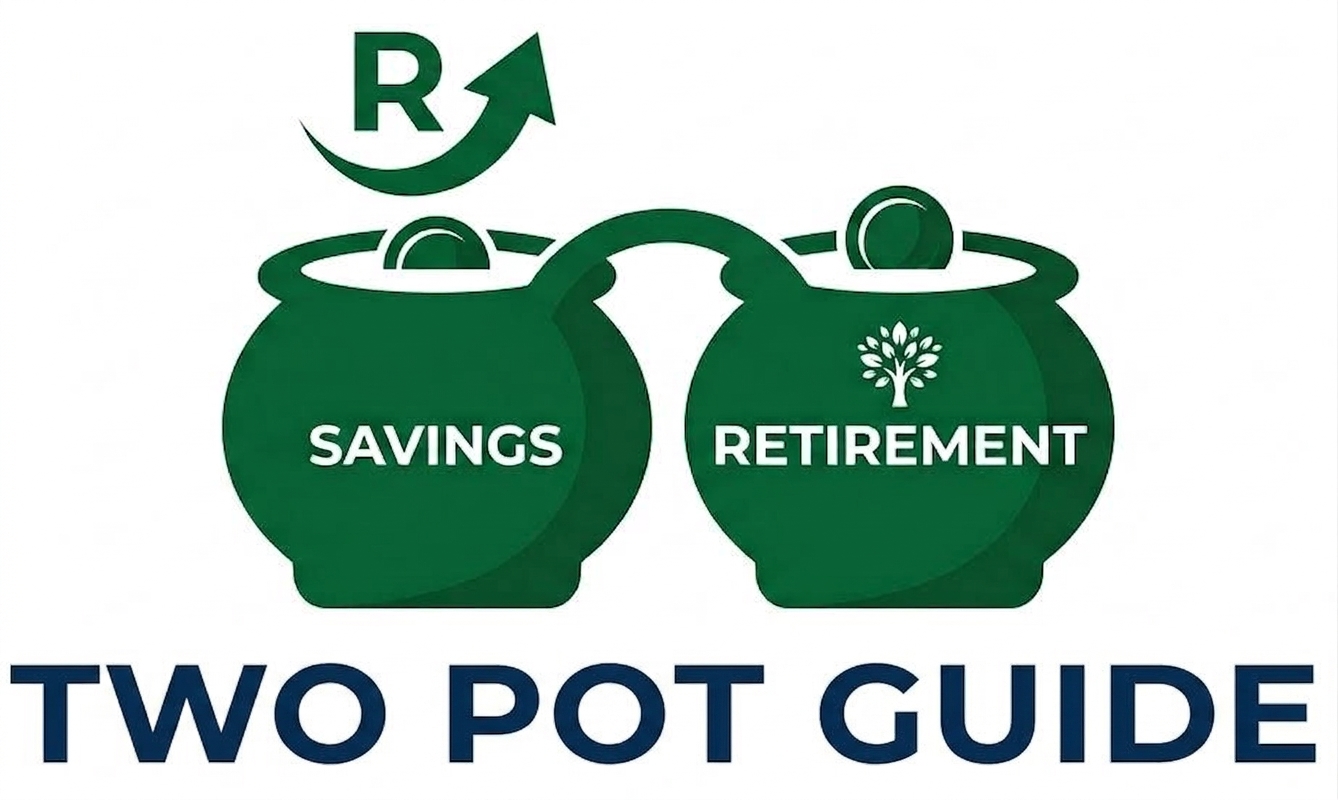
If you belong to a pension or provident fund through your job, retrenchment usually gives you the option to withdraw those retirement savings, transfer them to a new fund, or preserve them in a preservation fund until you retire. Since September 2024, the two-pot retirement system changes how part of that withdrawal works. Your fund is split into a savings pot holding one third of new contributions, which you can access relatively easily, and a retirement pot holding two thirds, which stays locked until formal retirement regardless of your employment status.
Retrenchment pay itself is a separate payment from your employer and is not part of your retirement fund, but many retrenched employees receive both at the same time and end up confusing the tax treatment of each. Your retrenchment pay follows the lump sum tax tables under a SARS tax directive, and your savings pot withdrawal, if you choose to access it, is taxed at your marginal income tax rate instead. Keep these two payments and their tax treatment separate when you plan your finances after retrenchment.
Frequently Asked Questions
Is retrenchment pay the same as severance pay?
Yes, retrenchment pay and severance pay refer to the same statutory payment under Section 41 of the BCEA, calculated at one week’s pay for every completed year of service. Different employers and articles use the two terms interchangeably.
Can my employer refuse to pay retrenchment pay if the business is struggling financially?
No. Retrenchment pay is a statutory entitlement, not a discretionary payment, and financial difficulty does not remove your employer’s legal obligation to pay at least the minimum set by the BCEA. You can refer a non payment dispute to the CCMA.
Does retrenchment pay get taxed the same way as my normal salary?
No. Retrenchment pay qualifies for special lump sum tax tables under a SARS tax directive, with a lifetime tax free threshold currently at R550,000 combined across severance and retirement fund lump sums, taxed on a sliding scale above that.
How long do I have to dispute an unfair retrenchment pay calculation?
You have 30 days from the date of your dismissal to refer a dispute to the CCMA using an LRA 7.11 form, whether the dispute is about the fairness of the process or the amount of retrenchment pay you were offered.
Read more: Retrenchment process in South Africa
Calculate your own retrenchment pay using your monthly remuneration and completed years of service before you accept whatever figure your employer offers, and check that figure against your payslip to confirm all guaranteed allowances were included. Ask for separate line items for notice pay and leave pay if they are missing from your final settlement. Before you decide what to do with the money once it lands, understanding how your retrenchment pay tax directive interacts with your two-pot retirement savings could save you from paying more tax than necessary.
This article is for informational purposes only and does not constitute legal or financial advice. Labour law and tax rules may change. For advice specific to your situation, consult a registered labour lawyer, a CCMA commissioner, or visit labour.gov.za and sars.gov.za.