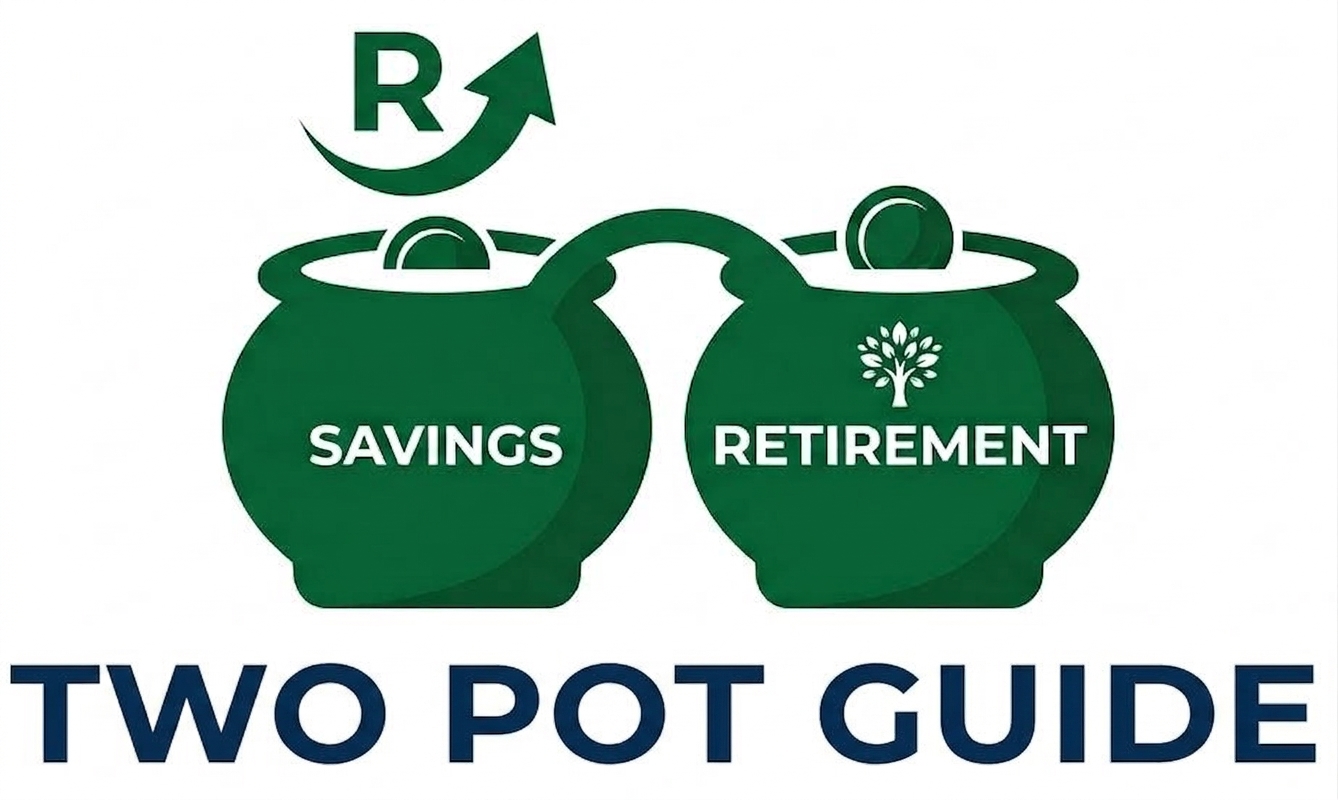


South Africa’s retirement savings system changed permanently on 1 September 2024. The two pot retirement system, introduced through the Revenue Laws Amendment Act, split retirement fund contributions into separate components for the first time, giving millions of South Africans limited access to their savings before retirement without forcing them to resign or cash out their entire fund.
Over a million withdrawal claims landed in fund administrators’ queues in the first three months alone. Some members benefited immediately from genuine emergency access. Others drained money they will spend thirty years trying to rebuild.
This article explains exactly how the two pot retirement system works: what the three pots are, what you can access and when, how SARS taxes withdrawals, and what the system means for your retirement outcome over time. Whether you are in a pension fund through your employer, a provident fund, or a retirement annuity with Old Mutual, Sanlam, Allan Gray, or Discovery, these rules apply to you.
The Three Components of Your Retirement Fund Under the New System
The name “two-pot” is slightly misleading. Your retirement fund now has three distinct components, each with different rules.
The savings pot receives one-third of every rand you contribute to your retirement fund after 1 September 2024. This is the portion you can access early. You can withdraw from it once per tax year, provided your savings pot holds at least R2,000. There is no upper limit on the withdrawal amount, but you can only take what is there.
The retirement pot receives two-thirds of every rand you contribute after 1 September 2024. This pot is preserved until retirement. You cannot touch it before then, regardless of your financial situation. At retirement, you use this pot to purchase an annuity or take a lump sum, depending on your fund type and the applicable rules.
The vested pot holds everything that accumulated before 1 September 2024. The old rules apply here. Pension fund members can access a portion as a lump sum at retirement. Provident fund members who were 55 or older on 1 March 2021 and stayed in the same fund retain the right to take their full vested pot as a lump sum at retirement. Younger provident fund members and pension fund members are subject to the old annuitisation requirements for the retirement component. Importantly, you cannot make an early withdrawal from the vested pot under the two pot retirement system framework, unless the old rules already permitted it.
In practice, what most fund members find is that their savings pot balance grows slowly in the early years. If you contribute R3,000 per month to your retirement fund, only R1,000 of that goes to the savings pot each month. After six months, you might have R6,000 in the savings pot before investment returns. After a full year, you are looking at roughly R12,000 to R14,000, depending on fund performance. This is meaningful emergency access, but it is not a parallel savings account.
What Happens When You Withdraw From the Savings Pot
The withdrawal process runs through your fund administrator. You do not apply to SARS directly. Fund administrators at Old Mutual, Sanlam Corporate, Momentum, Discovery, and umbrella fund platforms like Alexander Forbes all have member portals or employer HR systems where you submit your withdrawal application. The administrator then applies to SARS for a tax directive, deducts the applicable tax, and pays the remainder into your bank account.
SARS taxes savings pot withdrawals as ordinary income, at your marginal tax rate for the year. This is a different treatment from retirement fund lump sums at retirement, which benefit from a much more favourable tax table with significant exemptions. With a savings pot withdrawal, the amount you take out gets added to your other income for the tax year and taxed accordingly.
Take this example. Sipho earns R18,000 per month, giving him an annual income of R216,000. He withdraws R25,000 from his savings pot. SARS treats his total income for that year as R241,000. His marginal rate in the 2025/26 tax year is 26%. SARS instructs his fund administrator to withhold R6,500 in tax. Sipho receives R18,500 in his bank account.
Compare that to Ayanda, who earns R45,000 per month (R540,000 annually) and also withdraws R25,000. Her marginal rate is 36%. SARS withholds R9,000. She receives R16,000. Same withdrawal amount, very different result. The tax cost of accessing your savings pot scales with your income, which is a genuine deterrent for higher earners and something to factor in before applying.
The once-per-tax-year restriction is absolute. The South African tax year runs from 1 March to the last day of February. If you withdraw in May, you cannot withdraw again until the following March, even if your savings pot has grown significantly.
How the Two pot retirement system Affects Your Long-Term Retirement Outcome
Every withdrawal from your savings pot permanently reduces the capital available to grow for retirement. This is not a recoverable situation in the way that a temporary loan might be. You cannot pay the money back into the pot. Once it is withdrawn, that capital is gone from your retirement fund.
The compounding effect over twenty or thirty years makes this more significant than it appears at the point of withdrawal. R20,000 withdrawn today, at an assumed real return of 7% per year, would have grown to approximately R76,000 in real terms over twenty years. Over thirty years, the same R20,000 becomes roughly R152,000 in real terms. You are not just withdrawing R20,000. You are removing what that money would have become.
National Treasury designed the savings pot as an emergency facility, not a supplementary income stream. The architects of the system were explicit about this during public comment processes. The intent was to reduce the number of South Africans cashing out their entire retirement fund when they resigned, which was a well-documented pattern under the old system. The savings pot offers a release valve for genuine emergencies without destroying the entire retirement fund.
Whether members use it that way is another question entirely. In practice, a common situation is a member withdrawing the maximum savings pot balance every tax year from the first year the system launched, treating it as an annual bonus. Legally, there is nothing stopping them. Financially, the cost to their retirement income in twenty years will be real.
Common Misconceptions About the Two pot retirement system
Several misunderstandings have circulated since the system launched, some of them widespread enough to cause real financial harm.
The first is the belief that the savings pot is a large fund that members can access freely. Many members expected to find their entire historical fund balance split into thirds. That is not how it works. Only contributions made after 1 September 2024 feed into the savings and retirement pots. Your pre-September 2024 balance sits in the vested pot, inaccessible under the two-pot rules. A member with R500,000 in their fund at launch, who has contributed R3,000 per month since then, might have only R18,000 to R20,000 in their savings pot after twelve months. The vested pot stays separate.
The second misconception is that savings pot withdrawals are tax-free or taxed at a flat rate. They are not. SARS taxes them at your marginal income tax rate, which means the higher your salary, the more you lose to tax on each withdrawal. There is no threshold exemption for savings pot withdrawals, unlike the retirement fund lump sum table which exempts the first R550,000 cumulatively at retirement.
A third misunderstanding involves the GEPF. Government employees who are GEPF members often assume the two pot retirement system applies to them. It does not, at least not yet. The GEPF operates under the Government Employees Pension Law, not the Pension Funds Act, and was excluded from the 1 September 2024 implementation. National Treasury has indicated future inclusion, but the timeline remains uncertain.
The Three Pots at a Glance
| Component | What Goes In | Early Access Allowed | Tax on Early Access | ||
| Savings Pot | One-third of post-Sep 2024 contributions | Yes, once per tax year (min R2,000) | Marginal income tax rate | ||
| Retirement Pot | Two-thirds of post-Sep 2024 contributions | No | N/A before retirement | ||
| Vested Pot | All pre-Sep 2024 contributions | Old rules apply (generally no) | Retirement lump sum table at retirement |
How Your Fund Type Affects the Rules
The two pot retirement system applies broadly across fund types, but there are practical differences worth knowing.
Pension fund members have always been required to use at least two-thirds of their retirement fund to purchase an annuity at retirement. This rule continues to apply to the retirement pot. At retirement, your retirement pot must be annuitised, and your vested pot follows the old pension fund annuity requirements.
Provident fund members historically could take their full balance as a lump sum at retirement. Under the two pot retirement system, this changes for post-September 2024 contributions to the retirement pot. The retirement pot must be annuitised. However, provident fund members who were 55 or older on 1 March 2021 and have remained in the same fund retain their full lump sum rights for their vested pot.
Retirement annuity members deal directly with their insurer or investment house. Allan Gray, Old Mutual, Sanlam, Discovery, and Momentum all offer RA products that now include the two-pot structure. Retirement annuity rules also require full annuitisation of the retirement pot at retirement, consistent with the longstanding RA rules.
Preservation fund members can access their savings pot in the same way as active fund members. If you resigned from a previous employer and preserved your fund rather than cashing it out, that preserved fund now also operates under the two-pot structure for the post-September 2024 seeding allocation, which was a once-off transfer of 10% of your vested pot (capped at R30,000) into the savings pot at inception.
FAQ
How much can I withdraw from my savings pot?
You can withdraw any amount from your savings pot as long as it is at least R2,000 and does not exceed your current savings pot balance. There is no upper limit per withdrawal, but you are restricted to one withdrawal per tax year (1 March to end of February). If your savings pot holds R8,500, you can withdraw the full R8,500, or any amount down to R2,000.
What was the seeding allocation and do I still qualify for it?
When the two pot retirement system launched on 1 September 2024, each active fund member received a once-off seeding allocation into their new savings pot. This was 10% of their vested pot balance as at 31 August 2024, capped at R30,000. If your vested pot held R200,000 on that date, you received R20,000 in your savings pot at launch. If your vested pot held R400,000, you received the maximum R30,000. This seeding allocation happened automatically. Members who had zero balance or who joined a fund after 1 September 2024 did not receive a seeding allocation.
Can I access the two pot retirement system if I change jobs?
Changing jobs does not give you automatic access to your full fund balance. When you resign, you have the option to transfer your full fund (including savings, retirement, and vested pots) to a preservation fund or your new employer’s fund. You can also take your savings pot as a withdrawal at the point of resignation, but this triggers tax at your marginal rate. The retirement and vested pots cannot be cashed out on resignation under the two-pot rules for the retirement pot, though the vested pot may still have resignation access depending on fund rules.
Does the two pot retirement system apply to all South African retirement funds?
The two pot retirement system applies to all retirement funds regulated under the Pension Funds Act, including pension funds, provident funds, retirement annuities, and preservation funds. The notable exclusion is the GEPF, which is governed by the Government Employees Pension Law and has not yet been included. Certain other public sector funds may also be excluded. Check directly with your fund administrator if you are unsure of your fund’s status.
Read more: Two-pot system withdrawal limit
If you have not yet checked your savings pot balance, start there. Log into your fund administrator’s member portal or ask your employer’s HR department for your latest benefit statement. Knowing what is actually in your savings pot will anchor any decision you make about whether to withdraw.
If you are considering a withdrawal, work out the tax cost before you apply. Add the withdrawal amount to your expected annual income and check which marginal rate bracket that puts you in for the 2025/26 tax year. The tax hit on a savings pot withdrawal is real and immediate. The cost to your future retirement is deferred but equally real.
The two pot retirement system gives South Africans something that did not exist before: access to a portion of retirement savings without resigning or destroying the entire fund. Whether that access serves you depends entirely on how you use it. If you want to understand exactly what SARS will deduct before committing to a withdrawal, our detailed breakdown of two-pot withdrawal tax rates and marginal brackets will give you the numbers.
This article is for informational purposes only and does not constitute financial advice. Tax rules and fund regulations may change. Speak to a registered financial advisor or visit sars.gov.za for guidance specific to your situation.