
Two-Pot Calculator
This is an estimate, not financial advice.
R43 billion. That is roughly how much South Africans have pulled out of their retirement savings pots since the two pot system started on 1 September 2024. Most of them found out the hard way that the amount landing in their bank account is a lot less than the amount they asked for. This is exactly why a two pot calculator matters. It tells you, before you commit to anything, how much SARS will take and how much you will actually walk away with.
Once your fund submits your withdrawal request to SARS for a tax directive, you cannot cancel it, even if the tax bill shocks you. Getting the number right beforehand saves you from that nasty surprise. In this article we will walk through how the calculation actually works, what a two pot calculator does behind the scenes, where South Africans go wrong, and how to use the numbers to make a better decision about your own savings pot.
How a Two Pot Calculator Works Out Your Tax
A two pot calculator takes your annual income, adds your planned savings pot withdrawal on top of it, and then applies SARS marginal tax rates to the combined figure. This is the part that trips people up. Your withdrawal is not taxed on its own at some fixed rate. It gets added to your salary, bonus, and any other taxable income for the year, and SARS taxes the whole lot according to the normal income tax brackets.
For the 2025/26 tax year, the brackets run from 18% on the first R237,100 of taxable income, up to 26% between R237,101 and R370,500, 31% between R370,501 and R512,800, 36% between R512,801 and R673,000, 39% between R673,001 and R857,900, 41% between R857,901 and R1,817,000, and 45% above that. Everyone gets a primary rebate of R17,235, which effectively means you pay no tax at all if your total taxable income sits below R95,750 for the year.
Here is where a two pot calculator earns its keep. Say you earn R380,000 a year and you want to withdraw R40,000 from your savings pot. Without doing the maths, you might assume it gets taxed at 26%, since that is roughly your bracket on salary alone. But once you add the R40,000, your total taxable income becomes R420,000. Part of that withdrawal now falls into the 31% bracket instead of the 26% bracket, because your income has moved up a band. A decent two pot calculator shows you this bracket creep instantly, rather than leaving you to work it out with a pen and a tax table.
Why Your Withdrawal Amount Rarely Equals Your Payout
In practice, what most fund members find is that the number they request and the number that lands in their account are two very different things. If you have R60,000 in your savings pot and you request the full R60,000, your fund administrator sends that request to SARS, SARS calculates tax at your marginal rate, issues a tax directive, and your fund deducts that tax before paying you out.
Let's say your annual salary is R300,000 and you request R60,000 from your savings pot. Your combined taxable income for the year becomes R360,000, which pushes a chunk of that withdrawal into the 26% bracket. After tax, you might only receive around R44,000 to R46,000, depending on your other deductions and rebates. That is a R14,000 to R16,000 difference between what you asked for and what you actually got. A common situation we see is people budgeting around the gross figure, only to be caught short when the net amount arrives.
This is why using a two pot calculator before you apply matters more than most fund members realise. Rather than requesting a round number like R60,000 and hoping for the best, work backwards from the net amount you actually need. If you need R45,000 in your pocket, a calculator can help you figure out roughly what gross withdrawal to request so the after-tax amount matches what you need, instead of guessing and coming up short.
A Practical Example With Real Numbers
Take a fund member earning R250,000 a year who wants to withdraw R30,000 from their savings pot for a car repair and some school fees. Their salary alone sits comfortably in the 18% bracket. Add the R30,000 withdrawal and their taxable income for the year becomes R280,000, still within the 26% bracket threshold once you account for the primary rebate reducing the effective rate on lower income.
Running this through a two pot calculator, the withdrawal itself gets taxed at roughly 24% to 27% once blended with the rebate, leaving the member with somewhere between R22,000 and R23,000 net. That might still be enough to cover the car and part of the school fees, but it is not the R30,000 they had pictured. Compare that to a higher earner on R650,000 a year requesting the same R30,000. Because their salary already sits in the 36% bracket, that entire withdrawal gets taxed at 36%, leaving them with only around R19,200 net. Same withdrawal amount, very different outcome, purely because of where their income already sits.
This is the value of running your own numbers rather than assuming everyone gets taxed the same way. Standard Bank, Nedbank, ABSA, FNB, and Capitec all offer some form of online calculator or estimate tool through their retirement fund or investment platforms, and Old Mutual, Sanlam, Discovery, and Momentum provide similar tools for members invested through their retirement annuities and pension funds. SARS itself also has a directive calculation tool available through eFiling and the SARS MobiApp, which fund administrators use to confirm the exact tax before paying out.
Savings Pot vs Retirement Pot vs Vested Pot
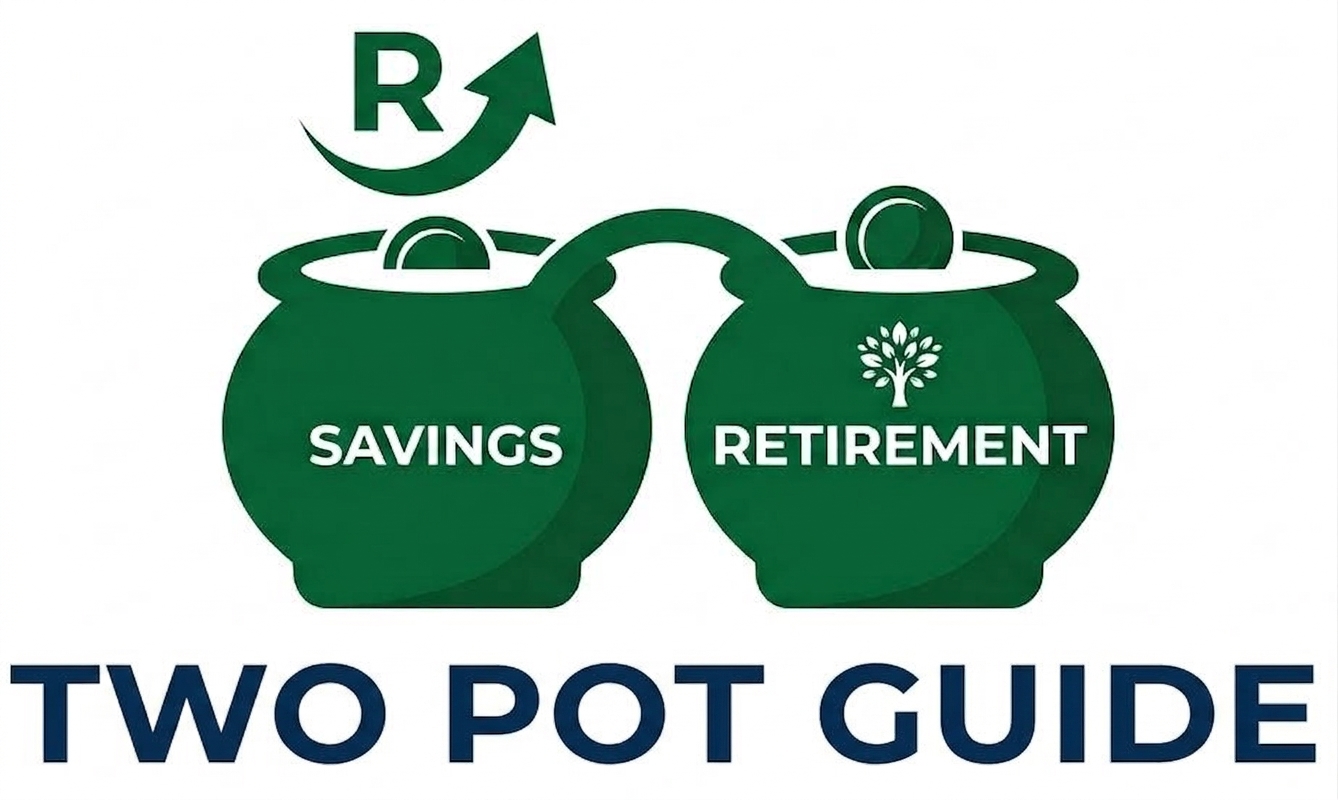
One misconception that catches a lot of South Africans out is thinking the two pot calculator applies to their entire retirement balance. It does not. It only applies to withdrawals from your savings pot. Your vested pot, which holds everything you had saved up until 31 August 2024, follows the old rules entirely and cannot be touched unless you resign or retire. Your retirement pot, which holds two thirds of your contributions since 1 September 2024, is locked away until retirement and can only be used to buy an annuity.
| Pot | What it holds | Access rules | Tax treatment | ||
| Vested pot | Savings built up before 1 September 2024 | Old rules apply, accessible on resignation or retirement | Taxed under retirement lump sum tables | ||
| Savings pot | One third of contributions since 1 September 2024, plus a once-off seed transfer | One withdrawal per tax year, minimum R2,000 | Taxed at your marginal rate, added to income | ||
| Retirement pot | Two thirds of contributions since 1 September 2024 | Locked until retirement | Must be used to buy a pension or annuity |
The seed capital transferred into your savings pot when the system launched was calculated as the lesser of R30,000 or 10% of your vested pot balance on 31 August 2024. If your vested pot was worth R200,000, you would have received R20,000 as seed capital. If it was worth R500,000, you would have been capped at R30,000, since 10% of that figure exceeds the cap.
The Mistake Most People Make With Their Savings Pot
A common mistake is treating the savings pot like a savings account you can dip into whenever cash gets tight, without checking what it costs you in tax each time. Unlike your vested pot or retirement pot, which get taxed under the more generous retirement lump sum tax table with a R550,000 lifetime tax-free portion, your savings pot withdrawal gets no such benefit. Every rand of it gets added to your taxable income for that year and taxed at your marginal rate from the very first rand.
Statistics from fund administrators show that most claims since the system launched have been under R10,000, and a high number of members are withdrawing again as soon as each new tax year opens on 1 March. Financial advisers at Investec and elsewhere have pointed out that while the system gives real flexibility for genuine emergencies, treating it as an annual bonus payout works against your long-term retirement outcome. Every rand you pull out today is a rand that stops compounding for the next twenty or thirty years. Run the numbers through a two pot calculator first, and you will often find that a smaller, better-timed withdrawal costs you far less in tax than a larger one that pushes you into a higher bracket.
What Happens If You Owe SARS Money
Before your savings pot payout reaches your account, SARS checks whether you have any outstanding tax debt. If you do, that debt gets deducted from your withdrawal automatically, and there is no way to stop it unless you already have a formal payment arrangement in place with SARS. A garnishee order on your salary does not count as a payment arrangement for this purpose. If you are unsure whether you owe SARS anything, you can send an SMS with your ID number to 47277 for a balance statement, or check your statement of account on eFiling before you apply for a withdrawal. SARS will also refuse to issue a tax directive at all if you have outstanding tax returns, so make sure your filing is up to date before you approach your fund.
Frequently Asked Questions
How accurate is a two pot calculator compared to what SARS actually deducts?
A good two pot calculator gives you a close estimate, usually within a few hundred rand, because it uses the same marginal tax bracket logic SARS applies. The final figure can differ slightly if you have other income, medical tax credits, or outstanding SARS debt that gets deducted first.
Can I use a two pot calculator for my retirement annuity savings pot?
Yes. The same tax rules apply whether your savings pot sits inside a pension fund, provident fund, or retirement annuity. The withdrawal still gets added to your taxable income for the year and taxed at your marginal rate.
Do I have to withdraw from my savings pot every year?
No. Withdrawal is entirely optional. If you leave your savings pot untouched, it keeps growing and gets paid out at retirement alongside your other savings, taxed under the more favourable retirement lump sum table instead of your marginal rate.
Why did my actual payout differ from what the calculator showed me?
The most common reasons are outstanding SARS debt being deducted first, a bonus or other income you did not include in the calculation, or your fund's processing fee being taken off the top before the tax calculation even happens.
Before you apply for a savings pot withdrawal, spend ten minutes with a proper two pot calculator and work out the net figure, not just the gross amount you think you need. Check whether the withdrawal pushes you into a higher tax bracket, confirm you have no outstanding SARS debt sitting against your name, and think honestly about whether this money is solving a real emergency or just plugging a gap that will reopen next month. If you decide to go ahead, understanding exactly how SARS calculates the tax on that payout will help you request the right amount from the start. See our breakdown of two pot withdrawal tax rates for a closer look at exactly how SARS applies these brackets to your specific payout.
Read more: Two-Pot System 2024 Withdrawal
This article is for informational purposes only and does not constitute financial advice. Tax rules and fund regulations may change. Speak to a registered financial advisor or visit sars.gov.za for guidance specific to your situation.